
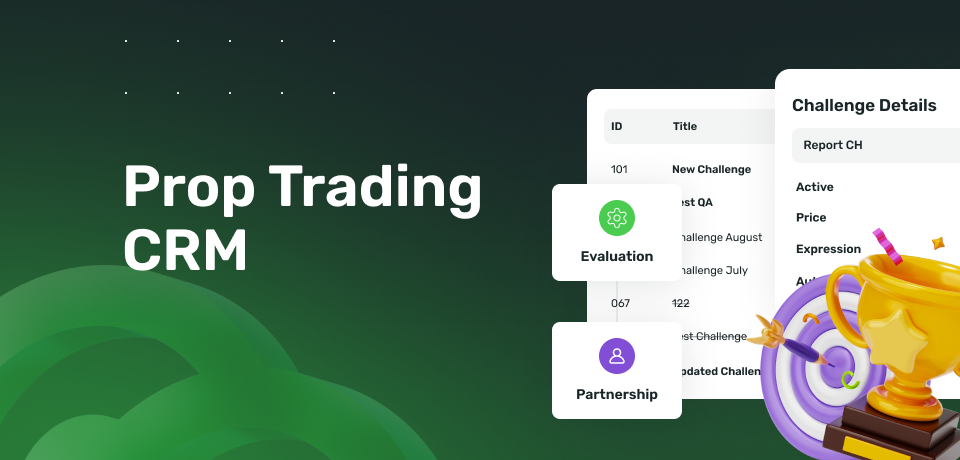
Proprietary trading firms, commonly known as prop trading firms, operate in a fast-paced and highly competitive financial environment. These firms provide capital to traders and allow them to trade financial markets such as forex, stocks, commodities, and cryptocurrencies. Managing a large number of traders, tracking their performance, ensuring compliance, and maintaining effective communication can be complex tasks. This is where CRM technology becomes essential.
A CRM for Prop Trading Firms helps firms streamline trader management, automate operations, and improve overall efficiency. Modern Trading CRM Software provides powerful tools that allow prop firms to manage traders from onboarding to performance evaluation while maintaining transparency and control. By integrating CRM technology into their operations, prop trading firms can significantly enhance how they manage traders and grow their business.
Understanding CRM for Prop Trading Firms
A CRM system designed for proprietary trading firms is more than a traditional customer relationship management platform. While standard CRM tools focus on managing customer data and interactions, a CRM for Prop Trading Firms is built to handle trader accounts, performance metrics, trading activity, risk management, and internal workflows.
With the help of specialized Trading CRM Software, prop firms can centralize all trader-related information in one platform. This includes trader profiles, evaluation progress, funded account details, trading history, and communication logs. Having all this information organized in one place allows firms to monitor trader behavior and performance more effectively.
Another advantage of CRM technology is automation. Instead of manually managing spreadsheets or scattered databases, prop firms can automate processes such as account approvals, trading evaluations, and trader notifications. This saves time and reduces the risk of human error.
Simplifying Trader Onboarding
One of the biggest challenges prop trading firms face is onboarding new traders efficiently. Many firms receive hundreds or even thousands of applications from traders who want to participate in their funded programs. Without an organized system, managing these applications can quickly become overwhelming.
A powerful CRM for Prop Trading Firms simplifies the onboarding process by automating application management. The system collects trader information, verifies details, and organizes applicants based on specific criteria. This ensures that firms can review applications quickly and make informed decisions.
Using Trading CRM Software, firms can also automate onboarding steps such as sending welcome emails, sharing trading guidelines, and assigning evaluation accounts. This creates a smooth and professional onboarding experience for traders while saving valuable time for the firm’s team.
In addition, CRM systems can track the progress of traders during evaluation phases. Managers can easily see which traders are passing challenges, which ones need assistance, and which accounts require review.
Centralized Trader Data Management
Managing trader information across multiple platforms can lead to confusion and inefficiencies. Prop firms need a centralized system that keeps all trader data organized and accessible.
A CRM for Prop Trading Firms acts as a central hub where all trader-related data is stored. From contact information and trading activity to account status and communication history, everything is available in one place.
This centralized approach makes it easier for firms to monitor trader performance and identify trends. Managers can quickly review trader profiles, analyze historical data, and make decisions based on accurate information.
With advanced Trading CRM Software, firms can also segment traders into different categories such as new applicants, active traders, funded traders, and high-performing traders. This allows the firm to tailor communication strategies and management approaches based on trader performance levels.
Performance Tracking and Analytics
Tracking trader performance is a critical part of managing a prop trading firm. Firms need to ensure that traders follow risk rules, maintain consistency, and achieve profitable results.
A well-designed CRM for Prop Trading Firms provides powerful analytics tools that allow firms to monitor trader performance in real time. Managers can track key metrics such as profit and loss, drawdown levels, trade frequency, and risk exposure.
Through Trading CRM Software, firms can generate performance reports and dashboards that display valuable insights about trader behavior. These reports help managers identify top performers as well as traders who may need additional support or guidance.
Analytics also allow firms to evaluate the effectiveness of their trading programs. By reviewing aggregated data from multiple traders, prop firms can refine their evaluation criteria and improve overall trading strategies.
Enhancing Communication with Traders
Communication plays a vital role in maintaining strong relationships with traders. Prop firms need to provide clear guidance, updates, and support to ensure traders understand the firm’s policies and trading rules.
A CRM for Prop Trading Firms improves communication by organizing all interactions between the firm and its traders. Emails, messages, notifications, and support requests can be tracked within the CRM system.
Using Trading CRM Software, firms can automate communication workflows. For example, traders can automatically receive alerts when they reach certain milestones, violate risk limits, or complete evaluation stages.
Automated communication ensures that traders stay informed and engaged without requiring constant manual effort from the support team. It also creates a professional experience that builds trust between the firm and its traders.
Risk Management and Compliance
Risk management is one of the most important aspects of operating a proprietary trading firm. Firms must ensure that traders follow strict risk guidelines to protect the company’s capital.
A specialized CRM for Prop Trading Firms integrates risk management tools that help firms monitor trader activity and enforce rules. The system can track trading limits, drawdown levels, and other risk parameters in real time.
With advanced Trading CRM Software, firms can receive alerts whenever a trader approaches or exceeds risk limits. This allows managers to take immediate action before losses become significant.
CRM systems can also help with regulatory compliance. By maintaining detailed records of trader activity and communications, prop firms can demonstrate transparency and accountability if required by financial regulators.
Automation of Administrative Tasks
Administrative work can consume a significant amount of time in prop trading firms. Tasks such as account management, data entry, reporting, and communication often require manual effort if no automation system is in place.
A modern CRM for Prop Trading Firms automates many of these routine tasks. Automated workflows can handle trader registrations, evaluation tracking, account upgrades, and notification messages.
By using Trading CRM Software, firms can significantly reduce operational workload and allow their teams to focus on strategic activities such as trader development and business growth.
Automation also improves accuracy. When tasks are handled automatically by the system, the risk of human error decreases, leading to more reliable operations.
Supporting Business Growth
As prop trading firms grow, managing a larger number of traders becomes more challenging. Without a scalable system, operations can quickly become disorganized.
A robust CRM for Prop Trading Firms provides the scalability needed to support business expansion. The system can manage thousands of traders while maintaining organized workflows and performance tracking.
Through scalable Trading CRM Software, firms can handle increasing trader volumes without sacrificing efficiency. Managers can monitor performance, communicate with traders, and manage accounts all within a single platform.
This ability to scale operations allows prop firms to expand their funded trader programs and attract more traders worldwide.
Conclusion
Effective trader management is essential for the success of any proprietary trading firm. As the number of traders grows, managing applications, performance data, communication, and risk controls becomes increasingly complex.
Implementing a powerful CRM for Prop Trading Firms provides a structured and efficient way to handle these challenges. By centralizing trader data, automating workflows, and offering real-time analytics, CRM systems significantly improve how prop firms manage their traders.
Modern Trading CRM Software not only simplifies daily operations but also enhances decision-making, improves communication, and strengthens risk management. For prop trading firms looking to grow and remain competitive in the financial markets, adopting CRM technology is no longer optional—it is a strategic necessity.